NAD+ vs GHK-Cu : A Clinical Comparison of Two Longevity Peptide Therapies
GHK-Cu vs NAD+: Two Longevity Therapies That Target Aging Differently.
This content is for educational purposes only and does not constitute medical advice. Consult a licensed medical provider before starting any peptide or supplementation protocol.
When patients ask about GHK-Cu vs NAD+, they are usually trying to answer one question: which one should I use first? Understanding the full range of ghk-cu benefits alongside core nad+ benefits makes this clearer. The honest clinical answer is that they are not competing. GHK-Cu is a copper-binding tripeptide that signals tissue repair and collagen remodeling. NAD+ is a coenzyme that fuels mitochondrial function and DNA repair. They target aging through entirely different mechanisms, which means the comparison matters more for sequencing and stacking than for choosing one over the other.
That said, budget, goals, and health status do require a choice in most cases. This breakdown covers both therapies from a clinical perspective so you can have an informed conversation with your provider.
Key Takeaways
GHK-Cu stimulates collagen synthesis, wound healing, and hair follicle activation at the tissue level.
NAD+ restores mitochondrial energy production and supports DNA repair at the cellular level.
The two therapies complement each other and are often used together in longevity protocols at clinics in Miami and Doral.
GHK-Cu is the stronger choice for skin, hair, and wound recovery goals; NAD+ is the stronger choice for energy, cognition, and metabolic health.
Both have low side effect profiles when administered under supervision, but dosage and delivery method matter significantly.
What Is GHK-Cu and How Does It Work?
GHK-Cu (glycyl-L-histidyl-L-lysine copper) is a naturally occurring tripeptide found in human plasma, saliva, and urine. Concentrations decline sharply with age: plasma levels drop from roughly 200 ng/mL at age 20 to under 80 ng/mL by age 60. That decline correlates with reduced skin elasticity, slower wound healing, and thinning hair density.
The peptide works by binding copper ions and acting as a signaling molecule. Its core ghk-cu benefits operate through several overlapping mechanisms:
Collagen and elastin stimulation: GHK-Cu activates fibroblasts to produce type I and type III collagen, directly improving skin firmness and wound tensile strength.
Antioxidant and anti-inflammatory action: The peptide modulates SOD (superoxide dismutase) and other antioxidant enzymes, reducing oxidative stress in damaged tissue.
Hair follicle activation: GHK-Cu extends the anagen (growth) phase and stimulates proliferation of dermal papilla cells, the structures that anchor and nourish hair follicles.
Wound healing acceleration: Multiple studies confirm GHK-Cu shortens healing time for skin injuries, surgical wounds, and chronic ulcers by promoting angiogenesis and keratinocyte migration.
Gene expression remodeling: Research by Pickart and Margolina identified over 4,000 human genes regulated by GHK-Cu, including many involved in tissue repair and immune modulation.
What Is NAD+ and How Does It Work?
NAD+ (nicotinamide adenine dinucleotide) is a coenzyme present in every cell of the human body. It functions as an electron carrier in cellular respiration and as a substrate for sirtuins (longevity proteins) and PARP enzymes (DNA repair proteins). Like GHK-Cu plasma levels, NAD+ concentrations fall significantly with age, dropping approximately 50% between ages 40 and 60 in most tissues.
The core nad+ benefits extend well beyond energy alone. The primary nad+ benefits are bioenergetic and genomic rather than structural:
Mitochondrial function: NAD+ is required for the Krebs cycle and electron transport chain. Restoring NAD+ levels improves ATP production, which translates to better energy, endurance, and cognitive clarity.
Sirtuin activation: SIRT1 through SIRT7 are NAD+-dependent proteins that regulate gene expression, inflammation, and cellular stress responses. Higher NAD+ levels upregulate these pathways.
DNA damage repair: PARP1 consumes NAD+ to detect and repair DNA strand breaks. Maintaining NAD+ availability supports genomic integrity under oxidative stress.
Metabolic regulation: NAD+ influences insulin sensitivity, fat oxidation, and glucose homeostasis through its role in metabolic enzyme reactions.
Neurological support: NAD+ is critical for neuronal function, and its precursors (NMN, NR) have shown promise in reducing neuroinflammation markers in early research.
GHK-Cu vs NAD+: A Direct Clinical Comparison
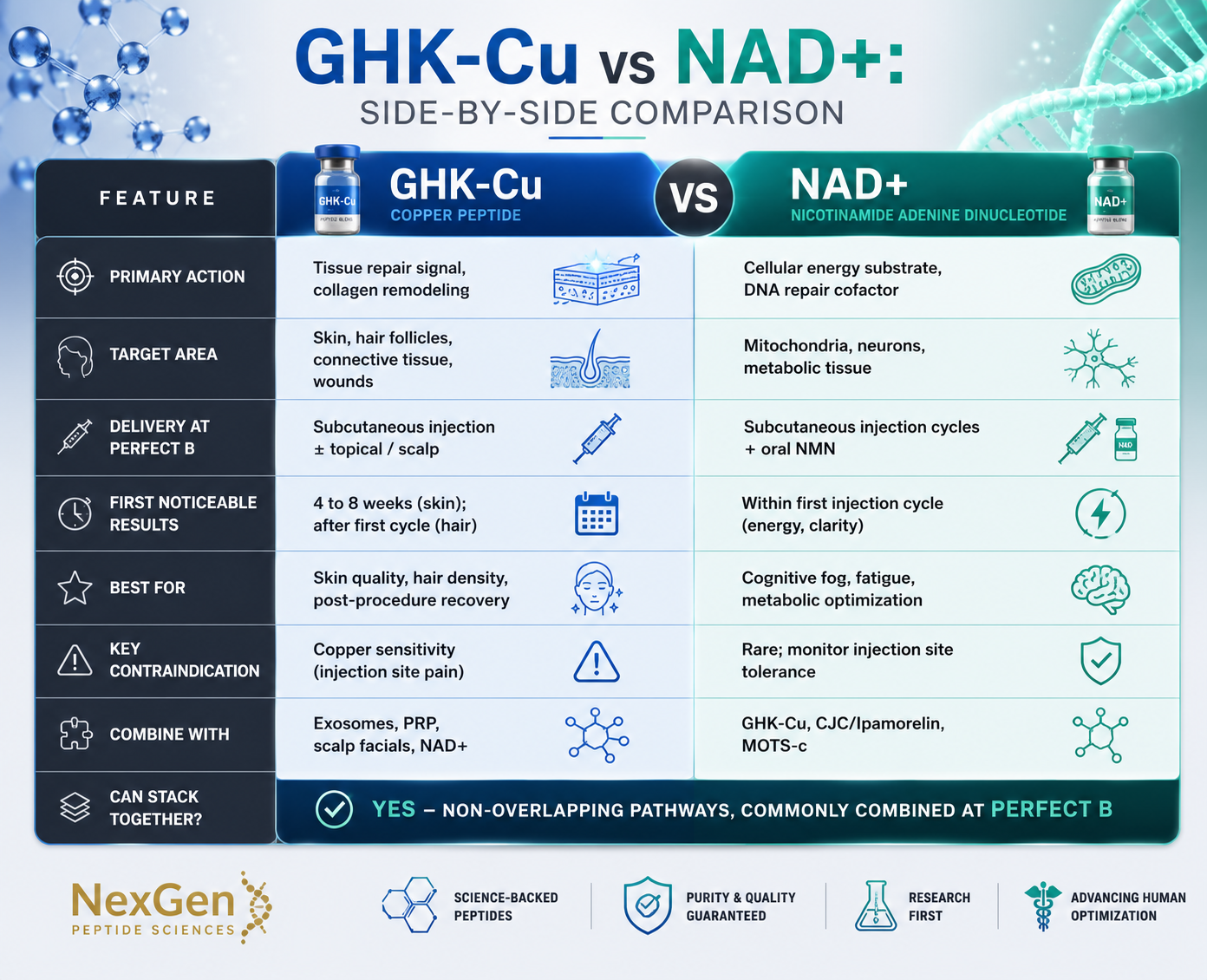
The full list of ghk-cu benefits becomes clearer in direct comparison. Understanding where each therapy excels makes the GHK-Cu vs NAD+ decision far less ambiguous. The table below represents a clinical summary of the two therapies across key categories:
Primary mechanism: GHK-Cu acts as a tissue repair signal; NAD+ acts as a cellular energy substrate.
Main target tissue: GHK-Cu targets skin, hair follicles, and wounds; NAD+ targets mitochondria, neurons, and metabolic tissue.
Speed of results: GHK-Cu shows measurable collagen changes within 4 to 8 weeks; NAD+ energy improvements are often reported within the first 1 to 3 infusions.
Best delivery method: GHK-Cu via subcutaneous injection or topical; NAD+ via subcutaneous injection cycles + oral NMN maintenance.
Strongest clinical evidence: GHK-Cu for wound healing, skin remodeling, hair loss; NAD+ for fatigue, metabolic dysfunction, and neurological support.
Side effect profile: Both are generally well tolerated; GHK-Cu rarely causes issues at therapeutic doses; NAD+ IV can cause flushing, nausea, or mild chest tightness if infused too quickly.
Can they be combined? Yes. They operate on non-overlapping pathways and are frequently stacked in longevity protocols.
Who Should Prioritize GHK-Cu?
Patients who come in primarily for aesthetic concerns, hair thinning, or post-procedure recovery tend to see the most clinical benefit from starting with GHK-Cu. The tissue-repair mechanisms are highly relevant to these goals in a way NAD+ is not.
The ghk-cu benefits most relevant to aesthetics patients include tissue remodeling, follicle activation, and inflammatory control. Ideal candidates for leading with GHK-Cu:
Patients with androgenetic alopecia or diffuse hair thinning who have not responded well to topical minoxidil alone
Patients seeking non-invasive skin rejuvenation with measurable collagen improvement
Post-laser or post-procedure recovery protocols where accelerated tissue repair is a priority
Patients with chronic skin conditions involving impaired wound healing (e.g., diabetic skin)
Individuals with visible signs of photoaging: fine lines, reduced elasticity, uneven texture.
Who Should Prioritize NAD+?
NAD+ is a better first choice for patients whose primary complaints are energy depletion, brain fog, metabolic slowdown, or mood instability. These are systemic issues driven by mitochondrial and bioenergetic decline, which GHK-Cu does not meaningfully address.
Ideal candidates for leading with NAD+:
Patients over 40 experiencing persistent fatigue that does not resolve with sleep or lifestyle changes
Individuals with metabolic syndrome, insulin resistance, or difficulty managing weight despite dietary effort
Patients recovering from substance use, where NAD+ has shown measurable benefit in reducing withdrawal symptoms and cravings
High-performance athletes or executives seeking cognitive edge and faster physical recovery
Patients with early neurodegenerative concerns who want evidence-supported mitochondrial support.
GHK-Cu Dosage and NAD+ Dosage: What Clinical Protocols Actually Use
Dosing varies based on delivery route, patient body weight, and clinical goal. The following represents typical ranges used in supervised medical aesthetics and longevity programs; individual protocols will differ.
GHK-Cu Dosage (Injectable Protocol)
Standard ghk-cu dosage for subcutaneous injection typically ranges from 1 to 3 mg per day, administered 5 days on / 2 days off. Loading phases may run 4 to 6 weeks at the higher end of the range, followed by a maintenance dose of 1 mg/day 3 to 5 times per week. For hair restoration specifically, some protocols combine subcutaneous GHK-Cu with direct scalp injection (mesotherapy) to deliver the peptide closer to the follicle bulb.
Topical ghk-cu dosage is less standardized. Serums typically contain 1% to 3% GHK-Cu concentration. Penetration is limited compared to injection, but topical application is still clinically meaningful for surface skin remodeling when used consistently.
NAD+ Dosage (Subcutaneous Protocol)
At Perfect B, NAD+ is delivered subcutaneously in structured injection cycles, not via IV. A typical protocol involves daily or near-daily subcutaneous injections during an active cycle, followed by a transition to oral NMN supplementation (typically 250 to 500 mg/day) during the maintenance phase. This cycling approach keeps intracellular NAD+ levels elevated without requiring continuous clinical visits. The cycle length and dosing schedule are individualized based on patient response and goals.
All dosing decisions should be made with a supervising provider. Self-dosing from unverified peptide sources introduces contamination and underdosing risks that make outcome tracking unreliable.
GHK-Cu Side Effects and NAD+ Side Effects: What to Expect
Neither therapy has a concerning safety profile at clinical doses, but patients should understand what is normal and what warrants attention.
GHK-Cu Side Effects
Reported ghk-cu side effects in clinical settings are rare and typically mild. Subcutaneous injection may produce localized redness, minor swelling, or bruising at the injection site, which resolves within 24 to 48 hours. Some patients report temporary warmth or itching at the site. Systemic side effects are not well-documented in human studies at therapeutic doses. The primary risk with GHK-Cu is sourcing quality, as unregulated peptide products may contain impurities that cause reactions attributable to contamination rather than the peptide itself.
NAD+ Side Effects
NAD+ via subcutaneous injection is generally well tolerated. The most commonly reported side effect is injection site discomfort or mild local reactions, which resolve quickly. Some patients experience brief fatigue or warmth shortly after injection, which passes within an hour. Oral NMN at maintenance doses has an excellent safety profile at doses up to 1,000 mg/day in clinical studies. Unlike IV infusion, subcutaneous administration eliminates the flushing, nausea, and chest tightness that IV protocols can produce when infused too rapidly.
Can You Stack GHK-Cu and NAD+ Together?
Yes, and it is increasingly common in longevity-focused clinics in South Florida and nationally. The two therapies do not share metabolic pathways or compete for the same receptors, so combining them does not create pharmacological conflicts. The rationale for stacking GHK-Cu vs NAD+ together is additive rather than synergistic: GHK-Cu handles structural repair while NAD+ handles bioenergetics. The result is a protocol that addresses both tissue-level aging and cellular energy decline simultaneously.
Patients who respond well to combined protocols at our Doral clinic typically present with multiple goals: hair thinning alongside fatigue, or skin aging alongside metabolic sluggishness. When both vectors of decline are present, treating only one often produces incomplete results.
GHK-Cu vs NAD+ for Anti-Aging: Where the Evidence Actually Stands
Neither therapy has large-scale, long-term randomized controlled trial data in humans for anti-aging endpoints specifically. This is true of virtually every longevity intervention currently in use, including metformin. What exists is a strong mechanistic foundation for both, a growing body of human clinical data for specific applications, and decades of clinical observation in functional medicine and medical aesthetics settings.
For GHK-Cu, the strongest human evidence is in wound healing, diabetic ulcer treatment, and hair loss (multiple randomized trials in androgenetic alopecia). The anti-aging skin claims are supported by in vitro, animal, and observational human data, which is consistent with what providers and patients report clinically.
For NAD+, the strongest evidence is in metabolic disease, addiction recovery, and early neurodegenerative models. The energy and cognitive benefits are well-reported anecdotally and in smaller human trials, with larger trials currently underway. The nad+ benefits most reliably reproduced in clinical practice are: reduced fatigue, improved exercise tolerance, and sharper mental clarity within the first loading course.
Closing: The Clinical Bottom Line on GHK-Cu vs NAD+
GHK-Cu and NAD+ are both legitimate tools in the medical anti-aging toolkit, but they are not interchangeable. GHK-Cu is the better choice when the primary goal is tissue-level repair: skin quality, hair density, and wound recovery. NAD+ is the better first move when the presenting complaint is systemic: fatigue, brain fog, metabolic slowdown, or recovery from chronic stress. For patients who can pursue both, combining them in a structured protocol produces results that neither achieves alone because structural repair runs better when cellular energy is restored.
The key word throughout this decision is supervised. Both therapies produce better outcomes, better dosing accuracy, and better safety profiles when administered in a clinical setting rather than self-managed with online peptides.
This Research Use Only (“RUO”) Policy applies to research materials supplied by NexGen Peptide Sciences(“NexGen,” “we,” “us,” or “our”).
NexGen Peptide Sciences supplies research materials intended exclusively for legitimate laboratory, analytical, in-vitro, and pre-clinical research applications.
All products designated Research Use Only (RUO) are not intended for human or veterinary use or consumption.
Products sold by NexGen Peptide Sciences are not offered as drugs, dietary supplements, food products, cosmetics, or medical devices and are not represented as approved by the U.S. Food and Drug Administration (“FDA”) for therapeutic or diagnostic use.
NexGen Peptide Sciences does not provide dosing instructions, administration protocols, medical advice, or recommendations for human or animal use.
RUO products must not be used for diagnostic, therapeutic, preventative, or consumptive purposes or represented by the purchaser as intended for such purposes.
By purchasing RUO products from NexGen Peptide Sciences, the purchaser acknowledges and agrees that:
Products are purchased solely for legitimate research purposes.
Products are not intended for human or animal administration or consumption.
The purchaser is responsible for determining and complying with all applicable federal, state, local, and international laws and regulations.
The purchaser is responsible for maintaining appropriate facilities, equipment, procedures, training, and personnel for handling research materials.
The purchaser will not represent NexGen Peptide Sciences RUO products as products intended for human or veterinary use.
NexGen Peptide Sciences does not authorize use of its RUO products outside their stated research purpose. Any unauthorized use, handling, representation, resale, or application is contrary to the products’ designated intended use and is undertaken independently of NexGen Peptide Sciences.
Nexgen Peptide Sciences is a chemical supplier. NexGen Peptide Sciences is not a compounding pharmacy or chemical compounding facility as defined under Section 503A of the Federal Food, Drug, and Cosmetic Act, and is not an outsourcing facility as defined under Section 503B of that Act.
This policy should be read together with the Terms and Conditions, product-specific documentation, and other applicable policies published by NexGen Peptide Sciences.