What Is CJC-1295/Ipamorelin and Why Is It the Most Requested Stack?
If you have landed on this page searching what is CJC-1295 Ipamorelin, you are asking the right question. CJC-1295 Ipamorelin is a two-peptide combination that works together to stimulate your body’s own natural growth hormone release in a clean, selective way. CJC-1295 is a growth hormone-releasing hormone (GHRH) analog, and Ipamorelin is a selective growth hormone secretagogue. Prescribed together as an injectable peptide stack, they are the most commonly requested protocol and the most frequently searched growth hormone peptide in the United States. Volume on the primary search term has climbed from roughly 27,000 searches per month in late 2025 to over 60,000 per month in 2026, which tells you exactly how quickly this category is moving.
CJC-1295 Ipamorelin peptide therapy is not hormone replacement. It does not replace your growth hormone. It signals your pituitary gland to produce and release your own growth hormone in a pattern that more closely resembles what your body produced in your twenties. In practical terms that means deeper sleep, better recovery, improved body composition, and over months, meaningful shifts in lean muscle, fat distribution, skin quality, and overall steady-state energy.
CJC-1295/Ipamorelin in Miami: What a Supervised Peptide Protocol Looks Like
If you are researching CJC-1295/Ipamorelin, you are looking at the most prescribed growth hormone peptide stack in our clinic, and also one of the most misunderstood. The internet treats it like a performance shortcut. Inside a medical clinic, it is something more specific: a prescribed, supervised protocol designed to restore your body’s own growth hormone pulse, monitored with lab work over a defined cycle. The difference between those two framings is the difference between guessing and measuring.

This two-peptide stack is designed to support the body’s own growth hormone signaling, helping align recovery, sleep quality, and metabolic function within a supervised clinical protocol.
Key Takeaways CJC-1295 Ipamorelin
CJC-1295 Ipamorelin is a two-peptide stack combining a GHRH analog (CJC-1295) with a selective growth hormone secretagogue (Ipamorelin). They are prescribed together, not separately.
The stack stimulates your own growth hormone, not replacing it. This is fundamentally different from hormone replacement and is why it has a cleaner side effect profile than direct HGH.
The main reported benefits are deeper sleep, faster recovery, improved body composition (lean mass up, visceral fat down), better skin tone, and steady energy over 8 to 12 weeks.
Ipamorelin is selective, meaning it triggers growth hormone without spiking cortisol or prolactin, which is why this stack is preferred over older peptides like GHRP-6.
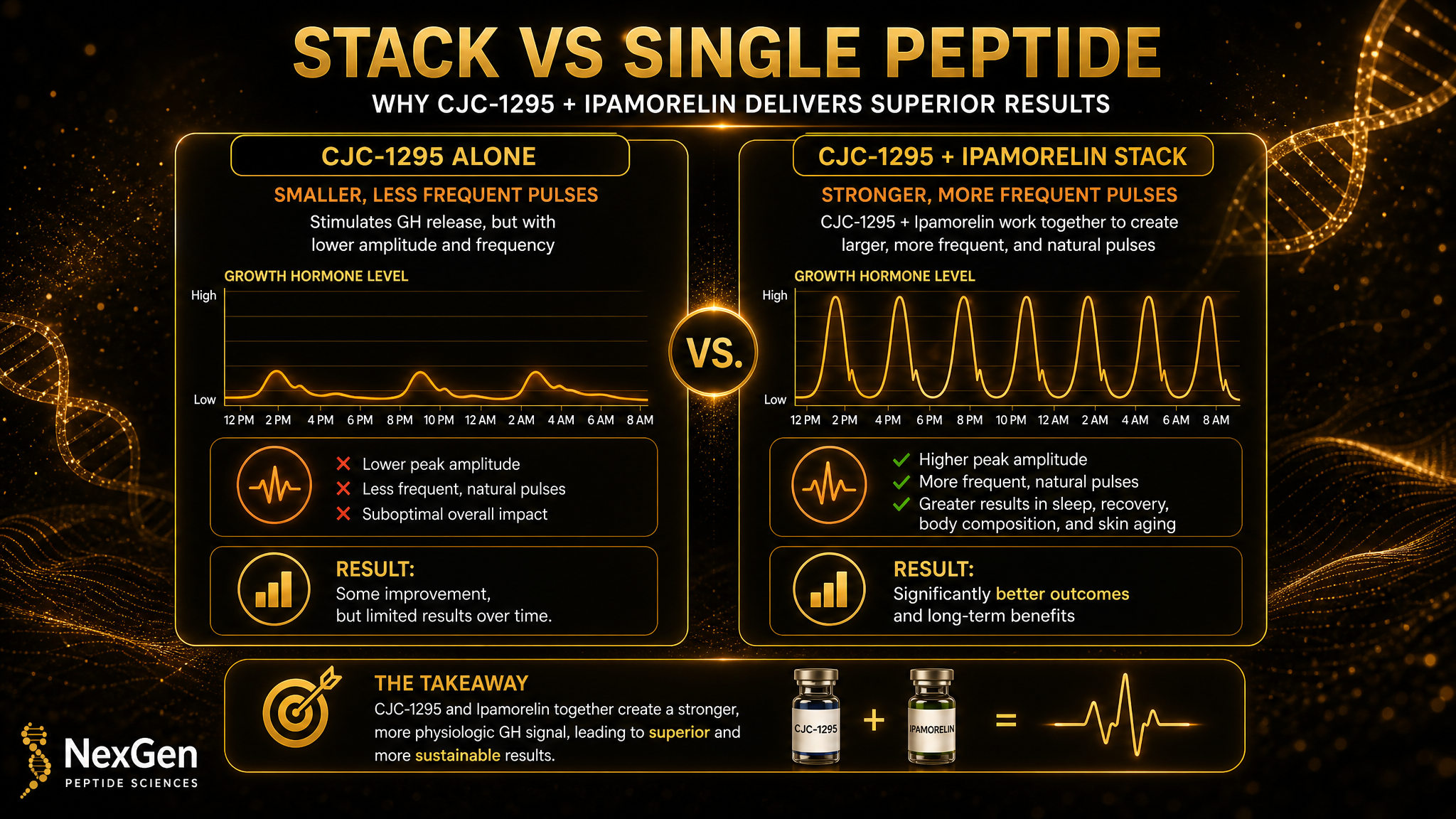
CJC-1295/Ipamorelin is a combination of two peptides that act on the growth hormone axis from two angles. CJC-1295 is a growth hormone releasing hormone (GHRH) analog: it tells the pituitary to produce growth hormone. Ipamorelin is a selective growth hormone secretagogue: it triggers a clean release pulse without spiking cortisol or prolactin. Prescribed together, they produce a larger, more natural pulse than either alone. They are prescribed as a pair, never separately.
The reason it is the most requested stack in our Doral clinic is that it stimulates your own growth hormone rather than replacing it, which is a fundamentally different and cleaner approach than direct HGH. For Miami patients in their thirties, forties, and beyond who notice lighter sleep, slower recovery, and a stubborn midsection, that mechanism speaks directly to what they are feeling.
The Full Breakdown of CJC-1295 Ipamorelin Peptide Stack
To understand what is CJC-1295 Ipamorelin peptide therapy, you have to understand what each peptide does on its own. Then you see why the combination works the way it does.
CJC-1295: The GHRH Analog
CJC-1295 is a synthetic analog of growth hormone-releasing hormone (GHRH), the hormone your hypothalamus naturally secretes to tell your pituitary to release growth hormone. Native GHRH has a very short half-life in the body, only a few minutes. CJC-1295 is modified (the version used in our clinic is CJC-1295 without DAC) to extend that signal, keeping the GHRH stimulus present long enough for a meaningful pulse of growth hormone to occur.
Ipamorelin: The Selective Secretagogue
Ipamorelin peptide is a selective growth hormone secretagogue. It binds to the ghrelin receptor in the pituitary and triggers growth hormone release through a completely different pathway from CJC-1295. What makes Ipamorelin clinically attractive is its selectivity. Older secretagogues like GHRP-6 also stimulate hunger, cortisol, and prolactin. Ipamorelin does not. It triggers a clean GH pulse without the hormonal noise, a finding documented in a peer-reviewed European Journal of Endocrinology study demonstrating that Ipamorelin stimulates growth hormone selectively without elevating ACTH, cortisol, or prolactin. That selectivity is exactly why this particular secretagogue, stacked with CJC-1295, has become the default growth hormone peptide protocol in modern medical clinics.
Why Stacking Both Works Better Than Either Alone
CJC-1295 and Ipamorelin act on two different receptor pathways at the same pituitary cell. One amplifies the hypothalamic signal, the other triggers release through the ghrelin system. Together they produce a growth hormone pulse that is larger and more physiologically clean than either peptide alone. The CJC-1295 Ipamorelin benefits patients actually report (better sleep, improved body composition, steadier recovery) are downstream effects of that combined GH pulse, repeated nightly for weeks.
How the Stack Restores Your Natural Growth Hormone Pulse
Growth hormone is not released in a steady stream. It comes in pulses, mostly at night during deep sleep, with the largest pulse in the first 60 to 90 minutes after you fall asleep. By the mid-thirties, those pulses have already started shrinking. By the forties and fifties, the amplitude is a fraction of what it was at twenty. Patients rarely complain about low growth hormone directly. They complain about lighter sleep, longer recovery windows, a stubborn midsection, and softer skin. Those are the downstream signs of a reduced GH pulse.
The CJC-1295/Ipamorelin stack is injected before bed, on an empty stomach, specifically to align the prompted pulse with your natural overnight window. The mechanism is well documented: this study showing how a CJC-1295 GHRH analog increases growth hormone and IGF-1 secretion while preserving the natural pulsatile pattern is part of why the stack is dosed at night rather than throughout the day.
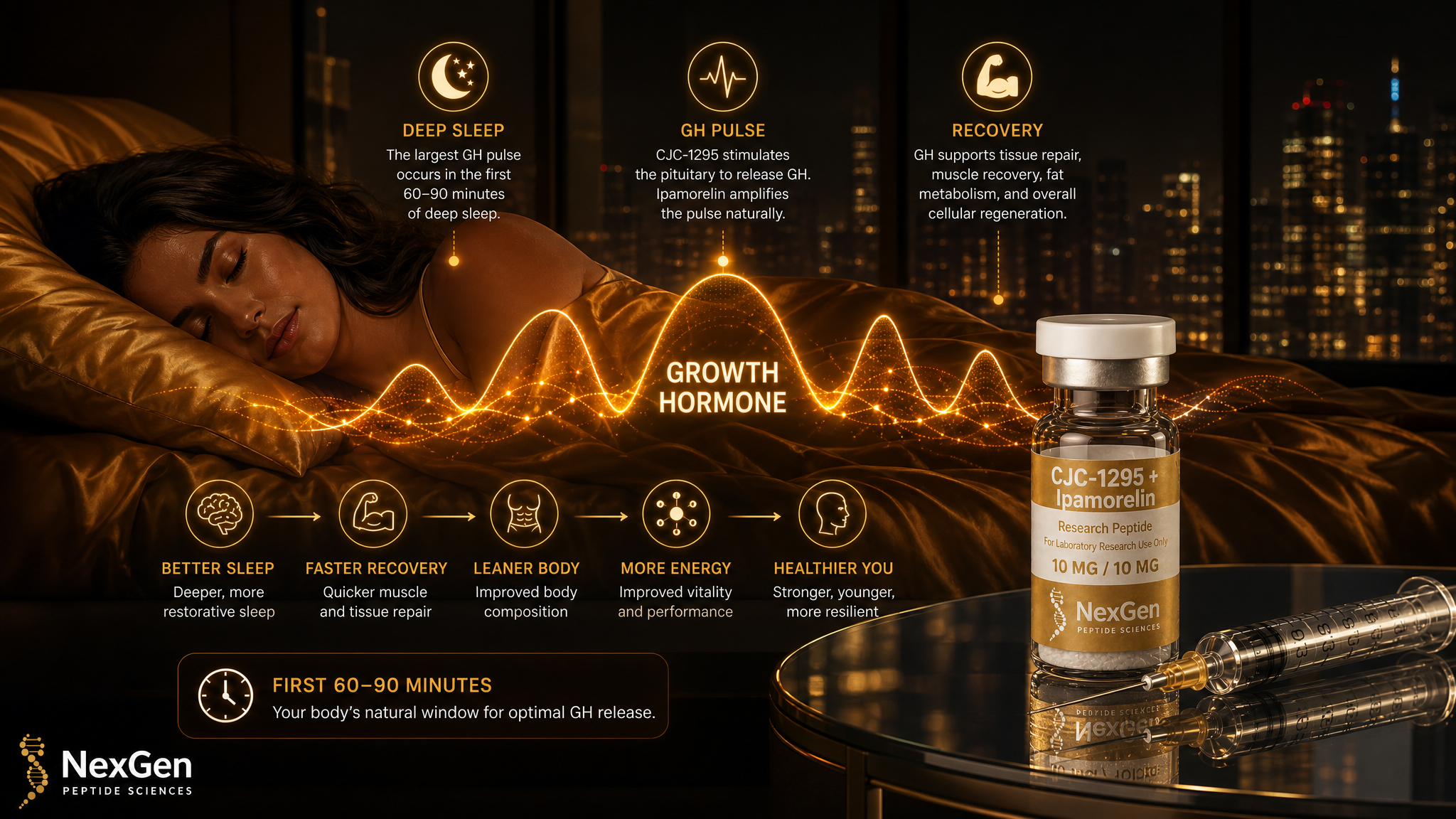
Growth hormone is released in natural pulses, with the largest surge occurring during the first stages of deep sleep. CJC-1295 and Ipamorelin are designed to support this physiologic rhythm rather than replace it.
CJC-1295/Ipamorelin Benefits
Benefits tend to unfold in a predictable pattern across a 12-week cycle. What patients report in our Doral consultations is remarkably consistent from one person to the next, with timing varying by age, baseline body composition, sleep habits, and training load.
Week 1 to 2: Sleep changes first. Falling asleep faster, sleeping more deeply, waking more rested. This is the earliest and most universal sign the stack is working.
Week 3 to 4: The recovery window shortens. Workouts that used to need two days to bounce back start turning over in one.
Week 5 to 8: Body composition shifts. Lean mass tends to climb and visceral fat tends to fall, which is where the InBody scan becomes useful for showing real change.
Week 8 to 12: Skin tone and steady daytime energy become noticeable, the slower-building benefits that show up once the GH pulse has been consistent for weeks.
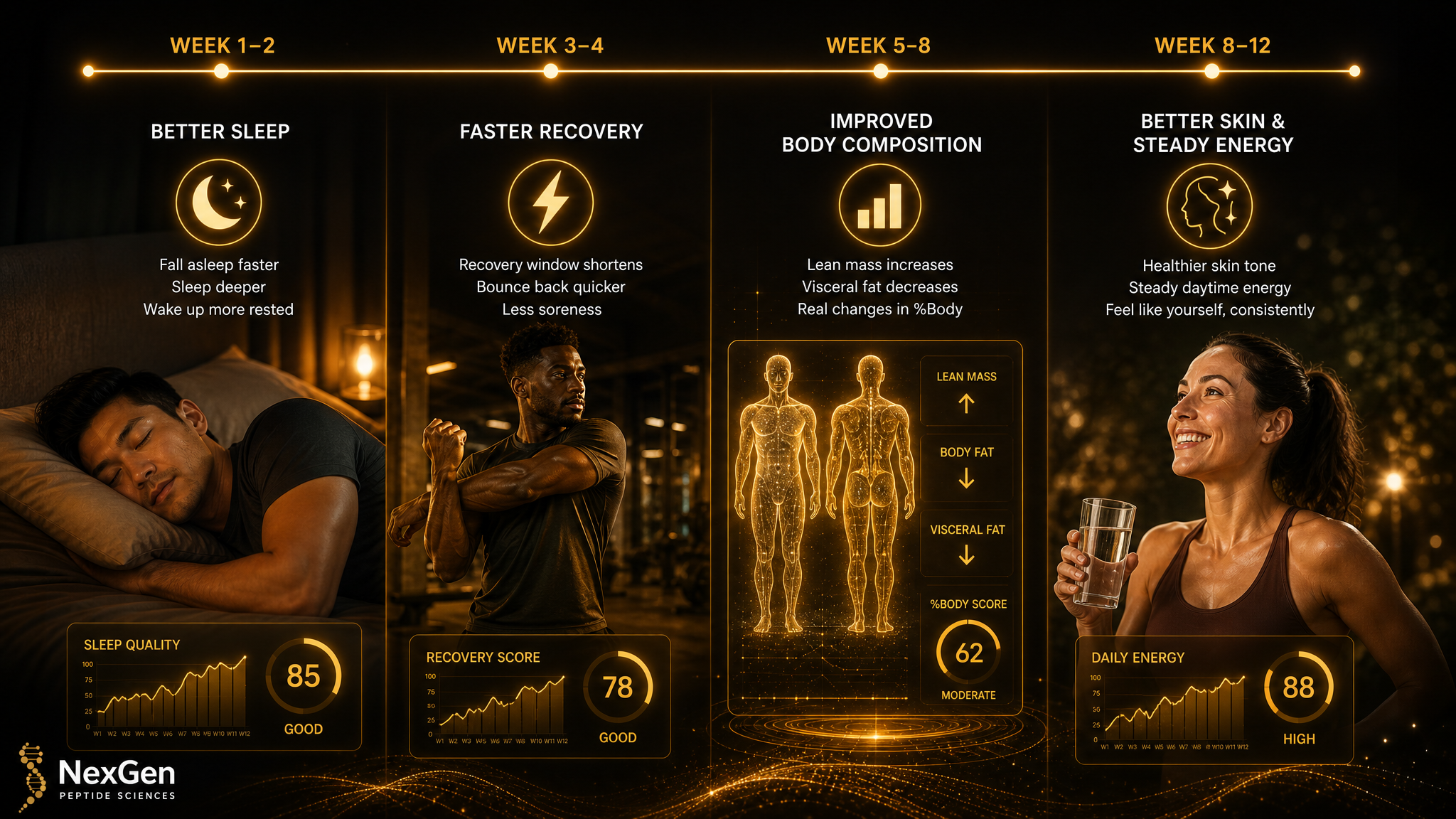
Most patients notice improvements in a predictable sequence. Better sleep often appears first, followed by faster recovery, measurable body composition changes, and later improvements in skin quality and daytime energy.
Who Is a Good Candidate for CJC-1295/Ipamorelin?
Not every patient who asks for CJC-1295/Ipamorelin is a candidate, and candid screening is part of what intake is for. The patients who get the most out of this stack share a common profile:Adults 30 to 65 noticing age-related shifts in sleep depth, body composition, and recovery that diet, training, and sleep hygiene alone have not fixed.Patients on GLP-1 medications (semaglutide, tirzepatide) who are losing weight but want to preserve lean muscle rather than just shrink.Active patients and athletes in United States who need faster recovery between training blocks, run under supervision instead of guesswork.
Screening also rules people out. A history of active cancer is a contraindication for growth hormone secretagogues, which is exactly why this stack should be prescribed after an evaluation rather than ordered online. For women specifically, the way the growth hormone axis shifts after 35 changes the conversation, which our team covers in detail in our guide to why the growth hormone axis changes for women after 35 and how a supervised CJC-1295/Ipamorelin protocol addresses it.
How CJC-1295/Ipamorelin Is Administered and Dosed
The cycle is simple in structure but requires precise execution. The route is subcutaneous injection with a small insulin-size needle, usually into the abdomen or thigh, with daily site rotation. Injections are done once daily before bed, at least two hours after the last meal. The empty-stomach timing matters because secretagogues like Ipamorelin are blunted when insulin is elevated from a recent meal, and the bedtime timing aligns the prompted pulse with your natural overnight window.
The exact dose, cycle length, and on-off schedule are individualized and part of the prescribed protocol, which is why we do not publish a one-size-fits-all number. For the full breakdown of injection timing, reconstitution, and cycle structure, our team details it in our guide to CJC-1295/Ipamorelin dosage, injection timing, reconstitution steps, and how long a typical cycle runs.
CJC-1295/Ipamorelin Side Effects and Safety
Side effects are generally mild and most often appear in the first week or two, then resolve as the body adapts. Because Ipamorelin is selective, this stack avoids the classic side effects of older secretagogues like aggressive hunger or a cortisol spike. What patients do report, usually transiently, includes a brief injection-site reaction, mild flushing across the face or chest for a few minutes after injection, and occasional tingling in the hands or feet that can signal the dose needs adjusting. The selectivity of Ipamorelin is documented in this research characterizing Ipamorelin as a selective growth hormone secretagogue that releases GH without significantly raising cortisol or prolactin, which is the safety feature that makes the stack tolerable for most patients.
CJC-1295/Ipamorelin is the most requested growth hormone peptide stack for good reason: it works with your own physiology, the benefits are consistent, and the side effect profile is favorable for the right candidate. But it is also a protocol where the monitoring is not optional. The molecule is the easy part. Knowing your dose is right, your IGF-1 is in range, and your body composition is actually changing is what turns it from an experiment into medicine.
If you are in Miami or Doral and considering CJC-1295/Ipamorelin, the safe path is the same one we use with every peptide patient: a consultation, candidacy screening, a compounded protocol built around your goals, and lab-based monitoring over the cycle. That is what supervised peptide therapy actually means.
This Research Use Only (“RUO”) Policy applies to research materials supplied by NexGen Peptide Sciences(“NexGen,” “we,” “us,” or “our”).
NexGen Peptide Sciences supplies research materials intended exclusively for legitimate laboratory, analytical, in-vitro, and pre-clinical research applications.
All products designated Research Use Only (RUO) are not intended for human or veterinary use or consumption.
Products sold by NexGen Peptide Sciences are not offered as drugs, dietary supplements, food products, cosmetics, or medical devices and are not represented as approved by the U.S. Food and Drug Administration (“FDA”) for therapeutic or diagnostic use.
NexGen Peptide Sciences does not provide dosing instructions, administration protocols, medical advice, or recommendations for human or animal use.
RUO products must not be used for diagnostic, therapeutic, preventative, or consumptive purposes or represented by the purchaser as intended for such purposes.
By purchasing RUO products from NexGen Peptide Sciences, the purchaser acknowledges and agrees that:
Products are purchased solely for legitimate research purposes.
Products are not intended for human or animal administration or consumption.
The purchaser is responsible for determining and complying with all applicable federal, state, local, and international laws and regulations.
The purchaser is responsible for maintaining appropriate facilities, equipment, procedures, training, and personnel for handling research materials.
The purchaser will not represent NexGen Peptide Sciences RUO products as products intended for human or veterinary use.
NexGen Peptide Sciences does not authorize use of its RUO products outside their stated research purpose. Any unauthorized use, handling, representation, resale, or application is contrary to the products’ designated intended use and is undertaken independently of NexGen Peptide Sciences.
Nexgen Peptide Sciences is a chemical supplier. NexGen Peptide Sciences is not a compounding pharmacy or chemical compounding facility as defined under Section 503A of the Federal Food, Drug, and Cosmetic Act, and is not an outsourcing facility as defined under Section 503B of that Act.
This policy should be read together with the Terms and Conditions, product-specific documentation, and other applicable policies published by NexGen Peptide Sciences.