IGF-1 LR3 for Muscle Growth: Dosing, Cycles, and How to Stack It.
A practical guide to using IGF-1 LR3 for muscle growth and body recomposition: how it works, starting doses, cycle structure, stacking with BPC-157 and GH secretagogues, and what to watch for.
When Is the Best Time to Take IGF-1 LR3? Timing, Safety, and Optimization Explained
IGF-1 LR3 has become one of the most discussed peptides in the world of performance optimization and longevity. But if there’s one factor that can dramatically influence results, it’s timing. When you take IGF-1 LR3 is not a small detail. It directly impacts how well it works, how your body responds, and even the potential risks involved.
This article breaks down the science behind IGF-1 signaling, explains the ideal timing windows, and explores how to use this compound in a more informed and strategic way. If you're interested in optimizing muscle growth, recovery, and metabolic health, understanding timing is essential.
Key Takeaways
IGF-1 LR3 works best in a fasted state when insulin levels are low and receptor availability is highest.
The post-workout window enhances IGF-1 signaling due to increased insulin sensitivity and muscle activation.
Elevated insulin can interfere with IGF-1 receptor binding and reduce effectiveness.
Improper dosing or elevated IGF-1 levels may increase risks such as water retention or unwanted cell growth.
Lab testing is essential to personalize protocols and avoid imbalances.
Understanding IGF-1 LR3 and How It Works
IGF-1 LR3 is a long-acting analog of insulin-like growth factor 1. Unlike natural growth hormone pulses that occur in short bursts, IGF-1 LR3 has an extended activity window of approximately 20 to 30 hours. This prolonged activation makes it powerful, but also requires a more thoughtful approach to timing and dosing.
In the body, IGF-1 plays a central role in recovery, tissue repair, and muscle growth. It supports brain health through the activation of BDNF and contributes to muscle development by stimulating satellite cells. In simple terms, growth hormone initiates the signal, but IGF-1 does much of the actual work.
Why Timing Matters More Than You Think
The effectiveness of IGF-1 LR3 largely depends on the hormonal environment in your body at the time of administration. Specifically, insulin plays a critical role in determining how well IGF-1 can bind to its receptors.
IGF-1 and insulin share similar signaling pathways, particularly the PI3K and AKT pathways. They also interact with structurally related receptors. When insulin levels are elevated, such as after a carbohydrate-rich meal, insulin tends to dominate receptor binding. This reduces the effectiveness of IGF-1 LR3.
This is why timing is not just a preference. It is a biological requirement for optimal results.
The Best Time to Take IGF-1 LR3
1. In a Fasted State
The most favorable condition for IGF-1 LR3 administration is a fasted state. After 8 to 12 hours without food, insulin levels are at their lowest. This creates an environment where IGF-1 receptors are more available and less competition exists.
Common fasted windows include:
First thing in the morning
Before bed, at least 90 minutes after eating
In these windows, IGF-1 LR3 can bind more efficiently and produce stronger signaling effects.
2. Post-Workout Window
Another highly effective time to use IGF-1 LR3 is after resistance training. Exercise increases insulin sensitivity, particularly in muscle tissue. This effect is strongest within the first 2 to 4 hours after training and can last up to 24 to 48 hours.
During this period, your muscles are primed to absorb nutrients and respond to anabolic signals. IGF-1 LR3 can take advantage of this environment to enhance muscle repair and growth.
Resistance training also increases GLUT4 translocation, which improves glucose uptake without requiring high insulin levels. This further supports a favorable environment for IGF-1 activity.
3. Avoiding High-Insulin States
One of the most important rules is to avoid taking IGF-1 LR3 when insulin is elevated. This includes:
Immediately after eating, especially carbohydrates
Late in the day after multiple meals
GF-1 LR3 (Insulin-Like Growth Factor-1 Long R3) is a modified analog of native IGF-1 that holds a unique position in the peptide stack: it acts directly at the IGF-1 receptor with a much longer half-life (~20–30 hours) than the natural version, which clears in under 15 minutes. That extended window means it can drive sustained muscle protein synthesis, satellite cell activation, and nutrient partitioning in a way that short-acting IGF-1 simply can't.
It's also one of the most commonly misdosed and misapplied peptides in biohacking circles. The goal of this guide is to fix that.
How IGF-1 LR3 Builds Muscle
IGF-1 LR3 binds to the IGF-1 receptor (IGF-1R) and activates two critical downstream pathways:
mTOR/PI3K/AKT pathway: The primary driver of muscle protein synthesis. IGF-1 LR3 directly stimulates this cascade, increasing the rate at which your body builds new muscle proteins after mechanical stress from training.
Satellite cell activation: Skeletal muscle has a population of stem-like satellite cells that, when activated, differentiate into myoblasts and fuse with existing muscle fibers — literally adding new nuclei and increasing muscle fiber density. IGF-1 LR3 is one of the more potent activators of this process in the peptide space.
Nutrient partitioning: IGF-1 LR3 acts similarly to insulin on nutrient uptake (glucose, amino acids) at the muscle level — meaning more of what you eat gets directed toward muscle tissue. This is both the benefit and the risk (see hypoglycemia notes below).
The "LR3" modification (a substitution at position 3 and an arginine extension) reduces IGF-1 LR3's affinity for IGF-binding proteins (IGFBPs). Native IGF-1 is heavily bound by IGFBPs in serum, which limits free activity. LR3 circumvents this, resulting in significantly higher free bioavailability at the receptor.
Who Should Consider IGF-1 LR3
IGF-1 LR3 is appropriate for:
Experienced users already running a solid foundation (training, protein, sleep)
People in an active recomposition phase wanting to accelerate lean muscle accrual
Those already running or familiar with GH secretagogues who want to add direct IGF-1 receptor stimulation
It's not appropriate for:
Beginners who haven't first established a baseline with training and nutrition
Anyone with active cancer history or elevated PSA (IGF-1 is mitogenic — it drives cell growth, not selectively)
People not monitoring blood glucose (hypoglycemia risk is real)
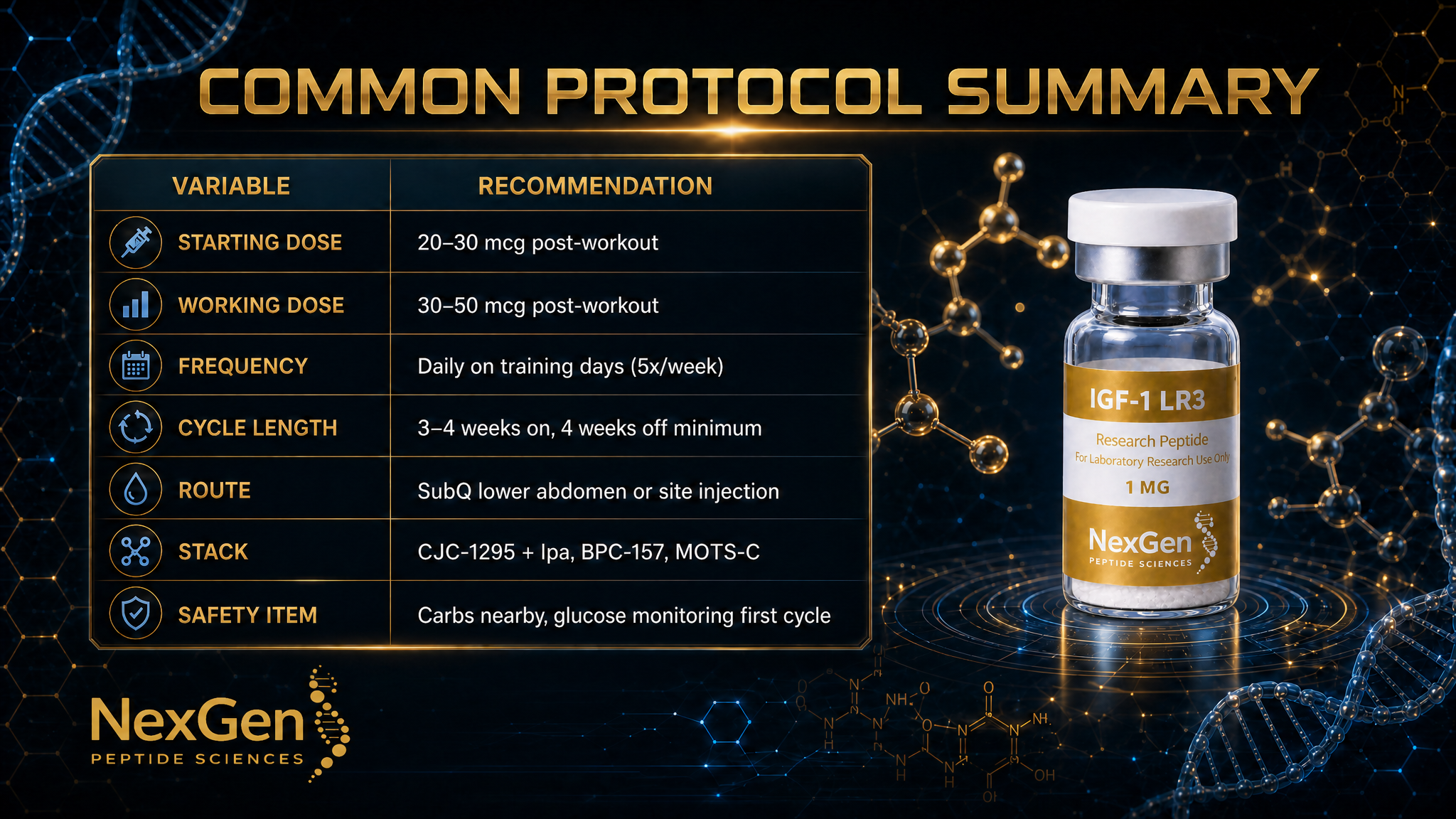
Starting Dose
20–30 mcg post-workout. This is the standard research-informed starting point. Start here for the first 1–2 weeks to assess hypoglycemia risk before titrating up.
Working Dose
30–50 mcg post-workout. Most users find their sweet spot in this range. Some protocols run 50–100 mcg but the risk/benefit ratio shifts considerably above 50 mcg without meaningful additional evidence of proportional benefit.
Timing
Post-workout is the standard. The rationale: mechanical stress from training upregulates IGF-1R expression and satellite cell sensitivity. Dosing into the post-workout window when receptors are most responsive maximizes the signal. Some protocols also use a pre-bed dose on non-training days but post-workout is the primary application.
Injection Route
SubQ (subcutaneous) is the most accessible and practical. Some protocols recommend intramuscular injection into the worked muscle ("site injection"), with the theory that local IGF-1R stimulation drives localized hypertrophy. The evidence for site injection advantage is not conclusive — subQ works.
Cycle Structure (This Is Where Most People Get It Wrong)
IGF-1 LR3 is not a compound to run continuously. This is the most common mistake.
The reason: prolonged continuous exposure downregulates IGF-1 receptor density (receptor desensitization). When you run it indefinitely, you progressively reduce your own receptor sensitivity — and the compound stops working while you're still paying for it.
Standard protocol:
Cycle length: 3–4 weeks on, 4 weeks off minimum
Some protocols: 21 days on, 4 weeks off (the "21-day cycle")
More conservative: 2 weeks on, 4 weeks off
Use the off-weeks to let receptor density recover. Many users report their best results in the first 3 weeks of each cycle precisely because receptor sensitivity is highest at that point.
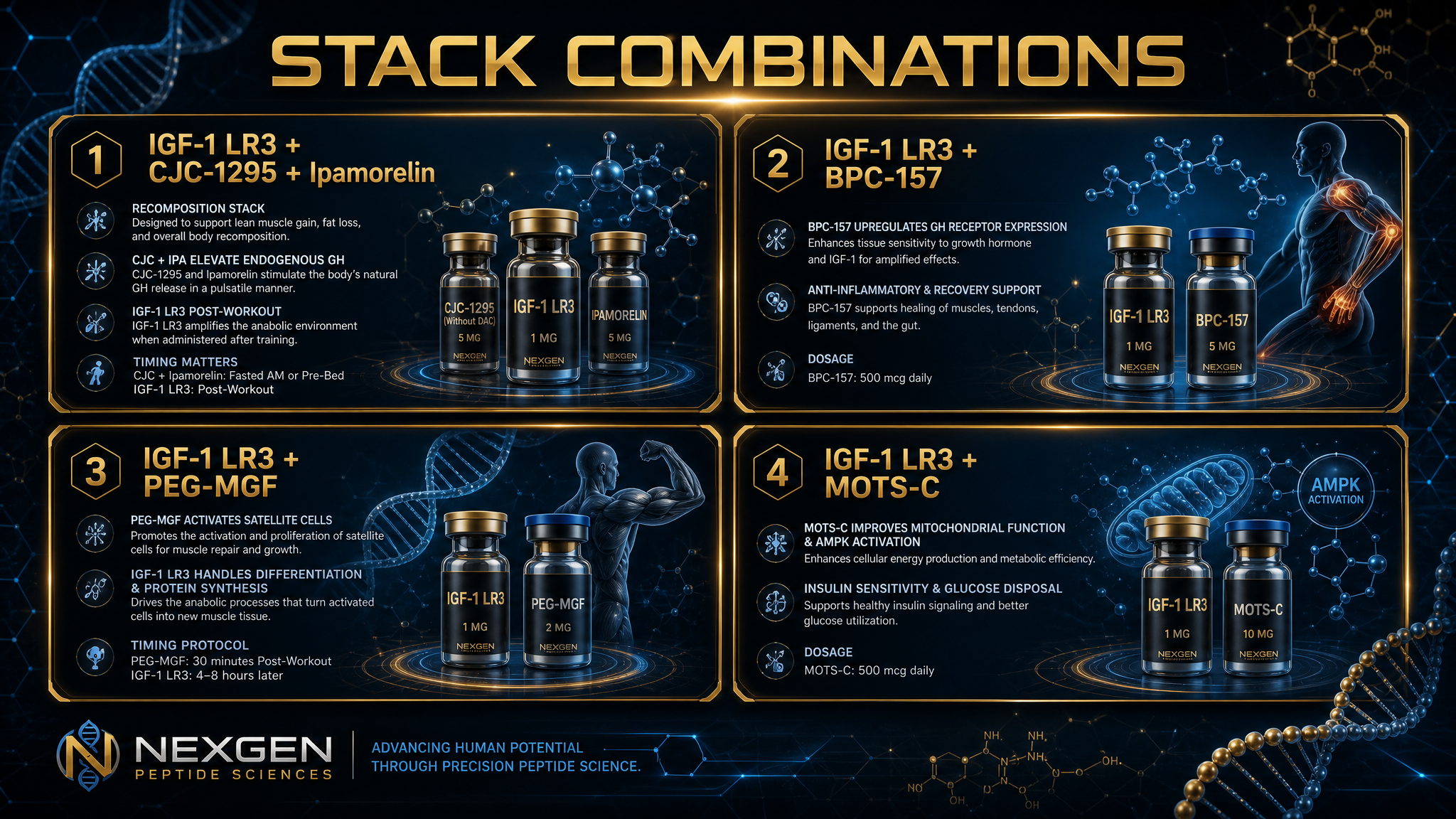
Stack Combinations
IGF-1 LR3 + CJC-1295 + Ipamorelin
One of the most popular recomposition stacks. CJC-1295 + Ipa elevates endogenous GH, which drives upstream IGF-1 production. Adding exogenous IGF-1 LR3 post-workout stacks direct receptor stimulation on top of that elevated GH signal. The combination targets both sides of the GH/IGF-1 axis.
Timing matters: CJC+Ipa fasted (AM or pre-bed), IGF-1 LR3 post-workout. Keep them separated so the IGF-1 LR3 hits during peak muscle sensitivity.
IGF-1 LR3 + BPC-157
BPC-157 upregulates growth hormone receptor expression, including in muscle tissue. This may enhance IGF-1 LR3 response by improving receptor signaling downstream. It also provides the anti-inflammatory and recovery support that allows you to train hard enough to benefit from IGF-1 LR3 in the first place. 500 mcg BPC-157 daily pairs well.
IGF-1 LR3 + PEG-MGF
PEG-MGF (pegylated mechano growth factor) is a splice variant of IGF-1 specifically expressed in muscle after mechanical stress. It activates satellite cells from a different angle than IGF-1 LR3 — early activation of muscle stem cell proliferation, while IGF-1 LR3 handles differentiation and protein synthesis. The combination is synergistic: PEG-MGF within 30 minutes post-workout, IGF-1 LR3 ~4–8 hours later. This two-wave approach targets different aspects of the muscle growth response.
IGF-1 LR3 + MOTS-C
MOTS-C improves mitochondrial function and AMPK activation, which directly supports the energetic demands of muscle growth. It also improves insulin sensitivity and glucose disposal, which matters with IGF-1 LR3 given the hypoglycemia risk. Running 500 mcg MOTS-C daily alongside IGF-1 LR3 can help stabilize blood glucose and improve overall metabolic response.
The Hypoglycemia Risk
IGF-1 LR3 has significant insulin-like activity at the glucose level. This is the primary safety concern:
Symptoms: shakiness, lightheadedness, diaphoresis (sweating), mental fog, and in severe cases loss of consciousness. These typically occur 30–90 minutes after injection.
Mitigation:
Always dose post-workout (your muscle uptake of glucose is highest then — blood glucose crash is less severe)
Have fast-acting carbs nearby for the first several doses (fruit, dextrose)
Never inject fasted
Start at 20 mcg and assess blood glucose response before titrating
Consider running a continuous glucose monitor (CGM) for the first cycle — Libre or Dexcom gives you real-time data
If you're already running GLP-1s (Reta, Tirz, semaglutide), add IGF-1 LR3 cautiously — the appetite suppression from GLP-1s means you may not feel hunger signals that would otherwise warn you about low blood glucose.
Labs to Monitor
Fasting IGF-1 level: Baseline before cycle, and mid-cycle. Elevated IGF-1 over long periods is associated with increased cancer risk — monitor, don't guess.
Fasting glucose / HbA1c: Track insulin sensitivity through the cycle
IGF-1 BP3 (binding protein 3): Context for how much IGF-1 is free vs bound.
Common Protocol Summary
Frequently Asked Questions
Q: Can I run IGF-1 LR3 every day including rest days?
You can, but the primary benefit is post-workout. On rest days, some users dose pre-bed. What you should not do is run it 7 days/week indefinitely — the receptor desensitization issue still applies. Stick to the 3–4 week cycle structure regardless of daily dosing.
Q: What's the difference between IGF-1 LR3 and IGF-1 DES?
IGF-1 DES is a truncated version (des(1-3)IGF-1) that has higher potency at the receptor (~5-10x) but a very short half-life (~20–30 minutes). It's typically used for site injections directly into muscle, where you want a localized burst rather than systemic effects. IGF-1 LR3 is the systemic version with extended half-life. They serve different roles.
Q: Can I stack IGF-1 LR3 with Retatrutide?
Yes, with caution. Reta's GLP-1 component suppresses appetite, which can mask early hypoglycemia warning signs. Monitor blood glucose more carefully. The combination does have theoretical synergy for body recomposition — GLP-1 driving fat loss, IGF-1 LR3 preserving and building lean mass during caloric restriction.
Q: Does it matter what I eat after dosing?
Yes. Prioritize protein and carbohydrates in the post-workout window when running IGF-1 LR3. The nutrient partitioning effect means your muscle uptake is elevated — you want substrate available. A meal with 40–50g protein + 50–80g carbohydrates in the 60-minute post-injection window is ideal.
Q: How long until I see results?
Most users notice improved pumps and recovery within the first week. Visible muscle changes typically emerge by week 2–3 of the first cycle. The real benefit compounds across multiple properly-cycled runs — don't judge it from one cycle alone.
This Research Use Only (“RUO”) Policy applies to research materials supplied by NexGen Peptide Sciences(“NexGen,” “we,” “us,” or “our”).
NexGen Peptide Sciences supplies research materials intended exclusively for legitimate laboratory, analytical, in-vitro, and pre-clinical research applications.
All products designated Research Use Only (RUO) are not intended for human or veterinary use or consumption.
Products sold by NexGen Peptide Sciences are not offered as drugs, dietary supplements, food products, cosmetics, or medical devices and are not represented as approved by the U.S. Food and Drug Administration (“FDA”) for therapeutic or diagnostic use.
NexGen Peptide Sciences does not provide dosing instructions, administration protocols, medical advice, or recommendations for human or animal use.
RUO products must not be used for diagnostic, therapeutic, preventative, or consumptive purposes or represented by the purchaser as intended for such purposes.
By purchasing RUO products from NexGen Peptide Sciences, the purchaser acknowledges and agrees that:
Products are purchased solely for legitimate research purposes.
Products are not intended for human or animal administration or consumption.
The purchaser is responsible for determining and complying with all applicable federal, state, local, and international laws and regulations.
The purchaser is responsible for maintaining appropriate facilities, equipment, procedures, training, and personnel for handling research materials.
The purchaser will not represent NexGen Peptide Sciences RUO products as products intended for human or veterinary use.
NexGen Peptide Sciences does not authorize use of its RUO products outside their stated research purpose. Any unauthorized use, handling, representation, resale, or application is contrary to the products’ designated intended use and is undertaken independently of NexGen Peptide Sciences.
Nexgen Peptide Sciences is a chemical supplier. NexGen Peptide Sciences is not a compounding pharmacy or chemical compounding facility as defined under Section 503A of the Federal Food, Drug, and Cosmetic Act, and is not an outsourcing facility as defined under Section 503B of that Act.
This policy should be read together with the Terms and Conditions, product-specific documentation, and other applicable policies published by NexGen Peptide Sciences.