 Image 1 of 2
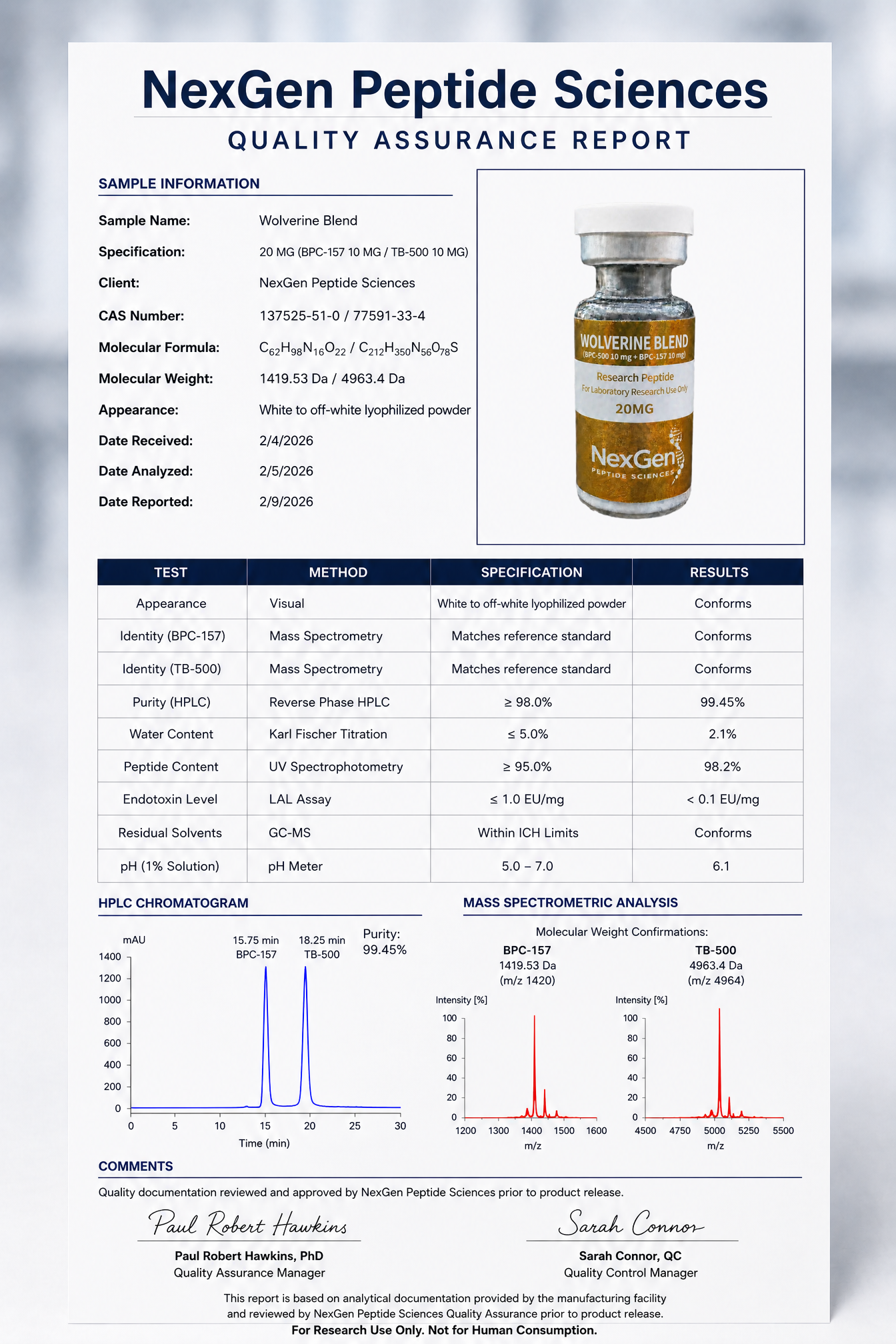 Image 2 of 2
"Wolverine Blend | BPC-157 and TB-500
⭐ ⭐ ⭐ ⭐ ⭐ 4.9/15 Based on verified feedback
The "Wolverine Blend" is a popular, synergistic combination of two synthetic peptides: BPC-157 and TB-500. Named after the fictional comic character known for rapid cellular regeneration, this protocol is widely utilized in experimental sports medicine and regenerative wellness to accelerate the healing of musculoskeletal injuries.
Core Components :
BPC-157 (Body Protection Compound-157): A 15-amino acid peptide derived from human gastric juice. It accelerates tissue repair by upregulating growth factors, reducing systemic inflammation, and promoting angiogenesis (the formation of new blood vessels).
TB-500 (Thymosin Beta-4 Fragment): A synthetic fraction of a naturally occurring cellular protein. It promotes actin-mediated cell migration, allowing healing cells to travel rapidly to the site of an injury to repair muscle fibers, tendons, and ligaments.
Primary Clinical Targets
Soft Tissue Repair: Accelerated healing of ligament tears, tendonitis, and muscle strains.
Joint Recovery: Reduction of chronic joint inflammation and support for cartilage remodeling.
Systemic Recovery: Enhanced systemic wound healing and reduced downtime after surgery.
🏥 Musculoskeletal Conditions (The Primary Targets)
The synergy between BPC-157’s collagen synthesis and TB-500’s cell migration makes the stack highly relevant for tissues with poor native bloodsupply:
1. Tendon and Ligament Injuries(Tendinopathies & Sprains)
Examples: Achillestendonitis, rotator cuff tears, patellar tendinitis, and partial ACL/MCL tears.
How it helps: Tendons and ligaments haveincredibly low blood flow, which iswhy they heal notoriously slowly. BPC-157 triggers angiogenesis (sprouting new blood vessels), while TB-500 delivers structural proteins like actin to pull new cells to the injury site. This dramatically accelerates the remodeling phase of connective tissue.
2. Skeletal Muscle Tears & Strains
Examples: Severe hamstring pulls, quadricep tears, and performance-related muscle overuse syndromes.
How it helps: The stack stimulates myogenesis (the creation of new muscle cells). It helps muscle fibers knit back together cleanly, which severely limits the creation of rigid internal scar tissue that would otherwise permanently decrease an athlete's flexibility.
3. Post-Surgical Orthopedic Recovery
Examples: Recovery following jointreconstruction surgeries, labrum repairs, or hardware implantation.
How it helps: By upregulating growthfactor receptors, the combination forces the body to skip past prolonged inflammatory phases and enter theproliferative healing phase rapidly, cutting down post-op downtime and accelerating the return of mobility.
🫄 Gastrointestinal & Systemic Conditions (BPC-157 Specifics)
While TB-500 manages systemic cell migration, BPC-157 wasoriginally isolated from human gastric juices, giving the stack secondary targets ingastroenterology:
4. Inflammatory Bowel Disease (IBD) & "Leaky Gut"
Examples: Ulcerative Colitis, Crohn’s disease, and severe gastric ulcers.
How it helps: BPC-157 is a highly potent cytoprotective agent in the gut. It acts directly on the mucosal epithelial lining of the stomach andintestines. It triggers rapid tissue repair of open ulcers and helps re-establish the tight junctionsof the gut wall to decrease systemic toxic leaks.
5. DelayedBone Fractures (Non-Union Fractures)
Examples: Severe bone breaks that refuse to fuse cleanly on their own or suffer from avascular necrosis (dead bone tissue from lack of blood).
How it helps: Preclinical research shows BPC-157 stimulates osteogenesis(bone cell creation). It builds a vascular bridge across fracturedbone gaps, encouraging calcification even in environments compromised by chronic corticosteroid use.
"The Wolverine Stack is utilized because it fixes the body's structurallayout. While BPC-157 acts as the General Contractor by building the blood vessels and protecting the gut barrier, TB-500 acts as the Logistics Officer, physically moving structural actin proteins to ensure cells repair muscle and tendon tissue without forming limiting scar tissue."
Product Details
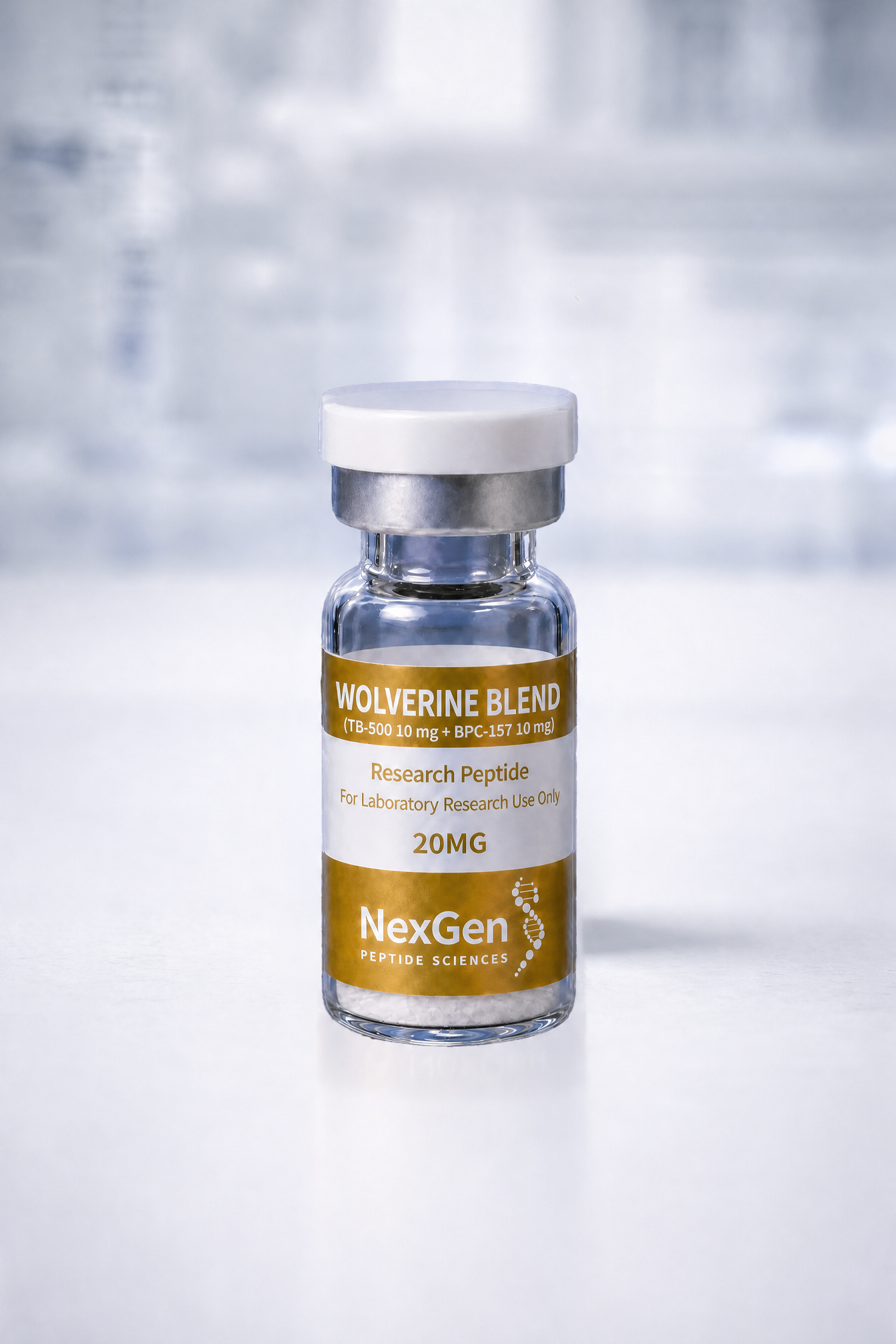
• Compound: Wolverine Blend
• Quantity: 20 mg
• Form: Lyophilized Powder
• Purity: ≥99% (if applicable)
• Storage: Store in a controlled laboratory environment, protected from light and moisture
Research Use Only
All products supplied by Nexgen Peptide Sciences are intended strictly for laboratory research use. They are not drugs, dietary supplements, food, cosmetics, not intended to diagnose, treat, cure, or prevent any disease or veterinary products, and are not for human or animal consumption.
Regulatory Status
Nexgen Peptide Sciences is a chemical supplier. NexGen Peptide Sciences is not a compounding pharmacy or chemical compounding facility as defined under Section 503A of the Federal Food, Drug, and Cosmetic Act, and is not an outsourcing facility as defined under Section 503B of that Act.
Intended Use and Handling
The products we offer are not intended for human use. They are intended for in-vitro and pre-clinical research purposes only. The customer acknowledges that risks exist in the handling, use, and distribution of these products, and certifies that it has the proper equipment, facilities, and personnel to manage those risks, and knowingly accepts them. These chemicals are not intended to be used, and should not be used, in inappropriate applications — including, without limitation, as food additives, drugs, cosmetics, or household chemicals, or in any application outside of in-vitro laboratory research, pre-clinical research, or laboratory chemical synthesis and materials testing.
Customer Responsibility
By purchasing these products, the customer agrees to the above. In the event the customer uses, or causes others to use, these products outside of these restrictions, the customer accepts all risk of doing so, absolves Nexgen Peptide Sciences of any responsibility for such actions, and agrees to indemnify and hold Nexgen Peptide Sciences harmless against any third-party claims arising from them.
This product is in powder form and is not reconstituted.All materials sold on this site are for laboratory research purposes only and are subject to our Terms and Conditions.
By purchasing, the buyer confirms this product will be used strictly for laboratory research purposes.
⭐ ⭐ ⭐ ⭐ ⭐ 4.9/15 Based on verified feedback
The "Wolverine Blend" is a popular, synergistic combination of two synthetic peptides: BPC-157 and TB-500. Named after the fictional comic character known for rapid cellular regeneration, this protocol is widely utilized in experimental sports medicine and regenerative wellness to accelerate the healing of musculoskeletal injuries.
Core Components :
BPC-157 (Body Protection Compound-157): A 15-amino acid peptide derived from human gastric juice. It accelerates tissue repair by upregulating growth factors, reducing systemic inflammation, and promoting angiogenesis (the formation of new blood vessels).
TB-500 (Thymosin Beta-4 Fragment): A synthetic fraction of a naturally occurring cellular protein. It promotes actin-mediated cell migration, allowing healing cells to travel rapidly to the site of an injury to repair muscle fibers, tendons, and ligaments.
Primary Clinical Targets
Soft Tissue Repair: Accelerated healing of ligament tears, tendonitis, and muscle strains.
Joint Recovery: Reduction of chronic joint inflammation and support for cartilage remodeling.
Systemic Recovery: Enhanced systemic wound healing and reduced downtime after surgery.
🏥 Musculoskeletal Conditions (The Primary Targets)
The synergy between BPC-157’s collagen synthesis and TB-500’s cell migration makes the stack highly relevant for tissues with poor native bloodsupply:
1. Tendon and Ligament Injuries(Tendinopathies & Sprains)
Examples: Achillestendonitis, rotator cuff tears, patellar tendinitis, and partial ACL/MCL tears.
How it helps: Tendons and ligaments haveincredibly low blood flow, which iswhy they heal notoriously slowly. BPC-157 triggers angiogenesis (sprouting new blood vessels), while TB-500 delivers structural proteins like actin to pull new cells to the injury site. This dramatically accelerates the remodeling phase of connective tissue.
2. Skeletal Muscle Tears & Strains
Examples: Severe hamstring pulls, quadricep tears, and performance-related muscle overuse syndromes.
How it helps: The stack stimulates myogenesis (the creation of new muscle cells). It helps muscle fibers knit back together cleanly, which severely limits the creation of rigid internal scar tissue that would otherwise permanently decrease an athlete's flexibility.
3. Post-Surgical Orthopedic Recovery
Examples: Recovery following jointreconstruction surgeries, labrum repairs, or hardware implantation.
How it helps: By upregulating growthfactor receptors, the combination forces the body to skip past prolonged inflammatory phases and enter theproliferative healing phase rapidly, cutting down post-op downtime and accelerating the return of mobility.
🫄 Gastrointestinal & Systemic Conditions (BPC-157 Specifics)
While TB-500 manages systemic cell migration, BPC-157 wasoriginally isolated from human gastric juices, giving the stack secondary targets ingastroenterology:
4. Inflammatory Bowel Disease (IBD) & "Leaky Gut"
Examples: Ulcerative Colitis, Crohn’s disease, and severe gastric ulcers.
How it helps: BPC-157 is a highly potent cytoprotective agent in the gut. It acts directly on the mucosal epithelial lining of the stomach andintestines. It triggers rapid tissue repair of open ulcers and helps re-establish the tight junctionsof the gut wall to decrease systemic toxic leaks.
5. DelayedBone Fractures (Non-Union Fractures)
Examples: Severe bone breaks that refuse to fuse cleanly on their own or suffer from avascular necrosis (dead bone tissue from lack of blood).
How it helps: Preclinical research shows BPC-157 stimulates osteogenesis(bone cell creation). It builds a vascular bridge across fracturedbone gaps, encouraging calcification even in environments compromised by chronic corticosteroid use.
"The Wolverine Stack is utilized because it fixes the body's structurallayout. While BPC-157 acts as the General Contractor by building the blood vessels and protecting the gut barrier, TB-500 acts as the Logistics Officer, physically moving structural actin proteins to ensure cells repair muscle and tendon tissue without forming limiting scar tissue."
Product Details
• Compound: Wolverine Blend
• Quantity: 20 mg
• Form: Lyophilized Powder
• Purity: ≥99% (if applicable)
• Storage: Store in a controlled laboratory environment, protected from light and moisture
Research Use Only
All products supplied by Nexgen Peptide Sciences are intended strictly for laboratory research use. They are not drugs, dietary supplements, food, cosmetics, not intended to diagnose, treat, cure, or prevent any disease or veterinary products, and are not for human or animal consumption.
Regulatory Status
Nexgen Peptide Sciences is a chemical supplier. NexGen Peptide Sciences is not a compounding pharmacy or chemical compounding facility as defined under Section 503A of the Federal Food, Drug, and Cosmetic Act, and is not an outsourcing facility as defined under Section 503B of that Act.
Intended Use and Handling
The products we offer are not intended for human use. They are intended for in-vitro and pre-clinical research purposes only. The customer acknowledges that risks exist in the handling, use, and distribution of these products, and certifies that it has the proper equipment, facilities, and personnel to manage those risks, and knowingly accepts them. These chemicals are not intended to be used, and should not be used, in inappropriate applications — including, without limitation, as food additives, drugs, cosmetics, or household chemicals, or in any application outside of in-vitro laboratory research, pre-clinical research, or laboratory chemical synthesis and materials testing.
Customer Responsibility
By purchasing these products, the customer agrees to the above. In the event the customer uses, or causes others to use, these products outside of these restrictions, the customer accepts all risk of doing so, absolves Nexgen Peptide Sciences of any responsibility for such actions, and agrees to indemnify and hold Nexgen Peptide Sciences harmless against any third-party claims arising from them.
This product is in powder form and is not reconstituted.All materials sold on this site are for laboratory research purposes only and are subject to our Terms and Conditions.
By purchasing, the buyer confirms this product will be used strictly for laboratory research purposes.